I’ve taught whole classes built around twists, and I always like to get a spinal twist in somewhere, often at the beginning and the end of class. But a twist can go two ways. It can be a long, spiraling spine. Or it can be a slumped spine with an arm cranking you around, which looks deeper but isn’t really doing much.
The difference comes down to one idea I repeat constantly: lengthen first, then twist. Breathe in to get tall. Breathe out to turn. Here’s how that plays out in seated and standing twists.
The breath pattern for every twist
In almost every twist I teach, you’ll hear some version of “inhale to lengthen, exhale to deepen.” Your inhale lifts you up through the crown of your head. Your exhale is when you turn a little further, drawing your belly button back toward your spine.
Then you repeat it. Inhale, find a little more length. Exhale, maybe a little more twist. It all depends on the depth of your twist, and wherever you are is great.
Twist from the base of your spine
The other cue you’ll hear from me all the time is “twist from the base of your spine up through the crown of your head.” The rotation starts low and spirals up. Imagine your spine is like a spiral staircase. You’re not collapsing. You’re sitting straight up and twisting.
Your head comes along last. Keep your head in line with your spine and shift your gaze as you deepen into the twist, looking out over your shoulder. You don’t need to crank your neck around to get there.
Seated twist, step by step
This is half lord of the fishes, a seated twist you’ll find in a lot of my classes.
- Sit with your left leg bent on the floor so your left knee points toward the front of your mat. Cross your right foot up and over and stamp it to the floor.
- Ground both sitting bones onto the floor. This is the foundation, so take a second to really feel both of them.
- Take your right hand out behind you. You can use it like a little kickstand.
- Inhale and lift your left arm up. Get tall.
- Exhale and hook your left elbow to the outside of your right knee, or just hug your knee.
- Keep your shoulders stacked over your hips, and look out over your right shoulder.
- Breathe here for a few breaths. Then unwind and switch sides.
If both sitting bones won’t stay grounded, take the twist to the level where they can. That might mean holding your knee instead of hooking your elbow. That’s great. It’s the same twist with better alignment.
If it’s hard to sit up with a tall spine, sit on a block or two.
The easier seated twist
The simplest version is a cross-legged twist, and it’s a good place to start. Sit cross-legged and reach both arms up overhead. Then bring your left hand to your right knee and your right hand out behind you. Inhale to lengthen. Exhale to deepen. Look out over your shoulder. Come back to center and switch sides. You can even do this one in a chair, with your hand on the back of the chair, keeping your shoulders stacked right over your hips.
Standing twists
Standing twists add balance and strength to the same idea. Your hips stay steady and your spine does the turning.
Twisted lunge. From a low lunge with your back heel lifted, bring your hands to your heart. Twist and hook your opposite elbow to the outside of your front knee. Press your palms together to deepen into the twist, and draw your thumbs toward your sternum (and your sternum toward your thumbs). Squeeze your inner thighs toward one another, even though they’re not touching, so everything draws toward the center. Lengthen your spine as you twist from the base.
Twisted chair. From chair pose, bring your hands to your heart and hook your elbow to the outside of the opposite knee. Keep your hips low. Keep your two knees in one line, so one knee doesn’t slide forward of the other.
Standing twist with your arms. From tall mountain or crescent lunge, bring one arm forward and one arm back. Keep your hips squared to the front of your mat. If one hip starts to drift back, draw it forward. Your core is what helps you reach further, not your hips swinging around.
In a standing twist, your gaze can go wherever is comfortable. Looking down at the floor helps your balance. If you feel steady, you can look up.
Common twist mistakes
- Rounding or slumping to get deeper. Don’t collapse to get deeper. Stay straight up and go only as far as you can keep the integrity of your spine.
- Cranking with your arm. Your arm helps, but your spine and core do the twisting.
- A sitting bone lifting off the floor. Back off until both are grounded.
- Hips swinging around in a standing twist. Keep your hips squared or level, and let only your spine turn.
- Leading with your head. Your head stays in line with your spine. Your gaze is the last thing to move.
As I said in one of my beginner classes, you want to keep the alignment, even if you’re not going very far or very deep, versus hunching or rounding to look further behind you. That one sentence is the whole article.
Practice it with me
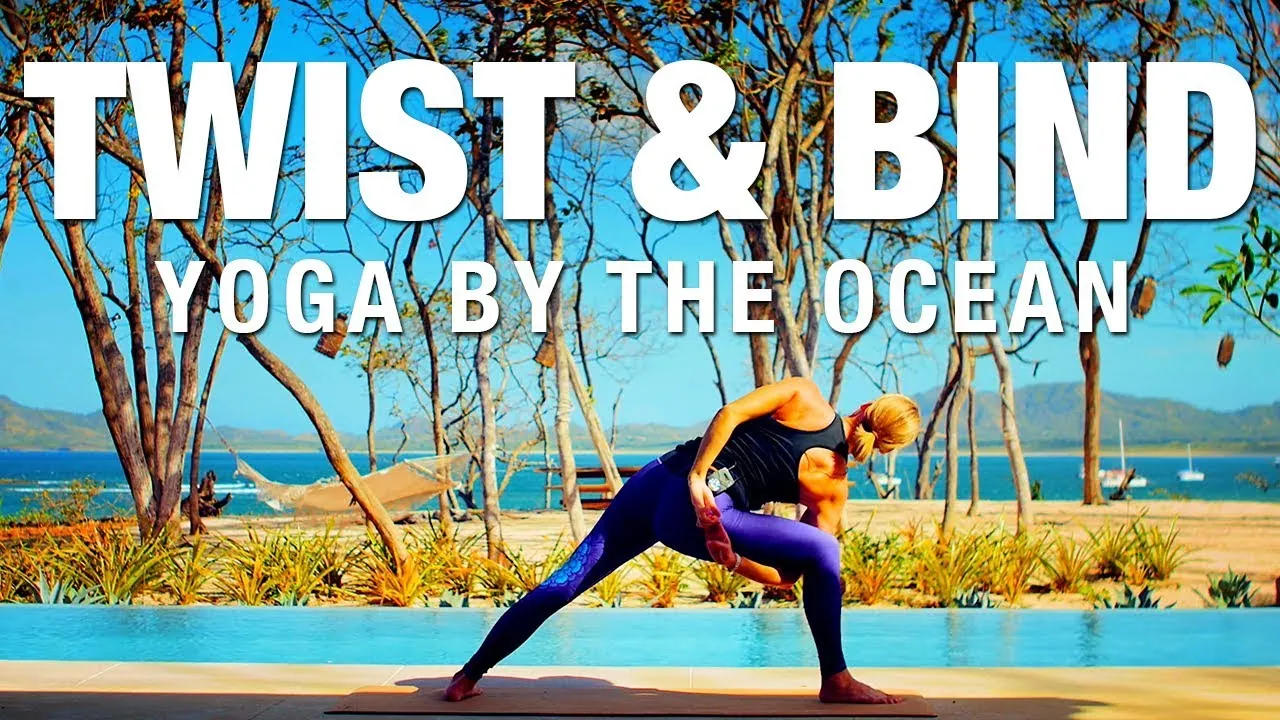
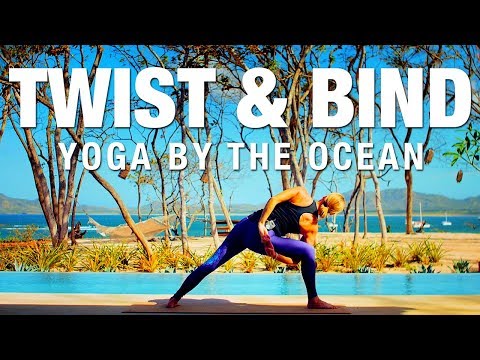
- Twist & Bind by the Ocean (1h 10m 14s). Twisted lunges and half lord of the fishes, filmed by the ocean in Costa Rica.
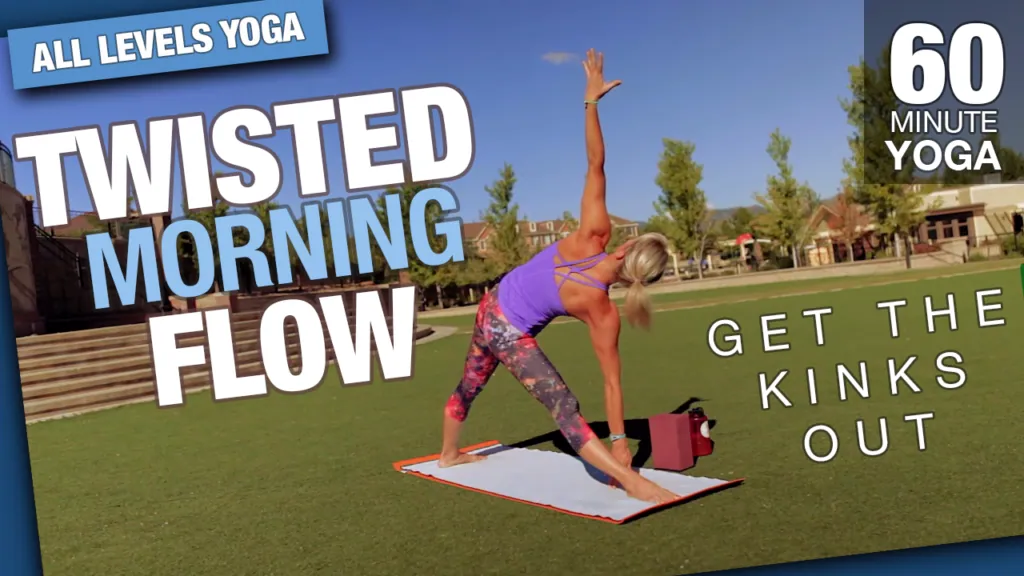
- Twisted Morning Yoga: Get the Kinks Out (59m 20s). Standing and seated twists with lots of cues about keeping your hips level.
- Twisting Flow Yoga Class (48m 45s). Inhale to lengthen, exhale to deepen, plus twisting chair.
- Yoga for Beginners (Bonus Iguana Visit!) (52m 42s). A gentle seated twist where we focus on alignment over depth.
- Toes to Head: 15 Minute Swimmers Stretch (17m 51s). A short class with the spiral staircase twist.
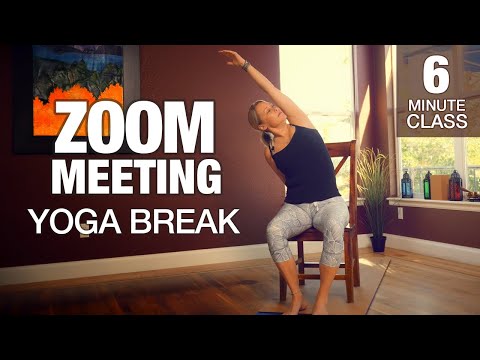
- Zoom Meeting Yoga Break (6m 27s). A seated twist you can do in your chair.
If you’d like to twist with me in person, come practice at our spring and November retreats in Nosara. And if you’ve been with us for a while and get something out of these free classes, you can support Five Parks Yoga here.
FAQ
Should I inhale or exhale into a twist? Inhale to lengthen your spine, then exhale to twist a little deeper.
Where should the twist come from? From the base of your spine, spiraling up through the crown of your head.
Do both sitting bones need to stay down in a seated twist? Yes. Take the twist only to the level where you can keep both sitting bones grounded.
Where should I look in a twist? Keep your head in line with your spine and let your gaze shift out over your shoulder. In standing twists, look down at the floor if you need help with balance.
What if I can’t sit up straight in a seated twist? Sit on a block or two, or try a twist in a chair.
Practice it with me


Get new classes from Erin
Free classes, retreat dates and the occasional note. Unsubscribe any time.